
Microsoft Teams
Housing

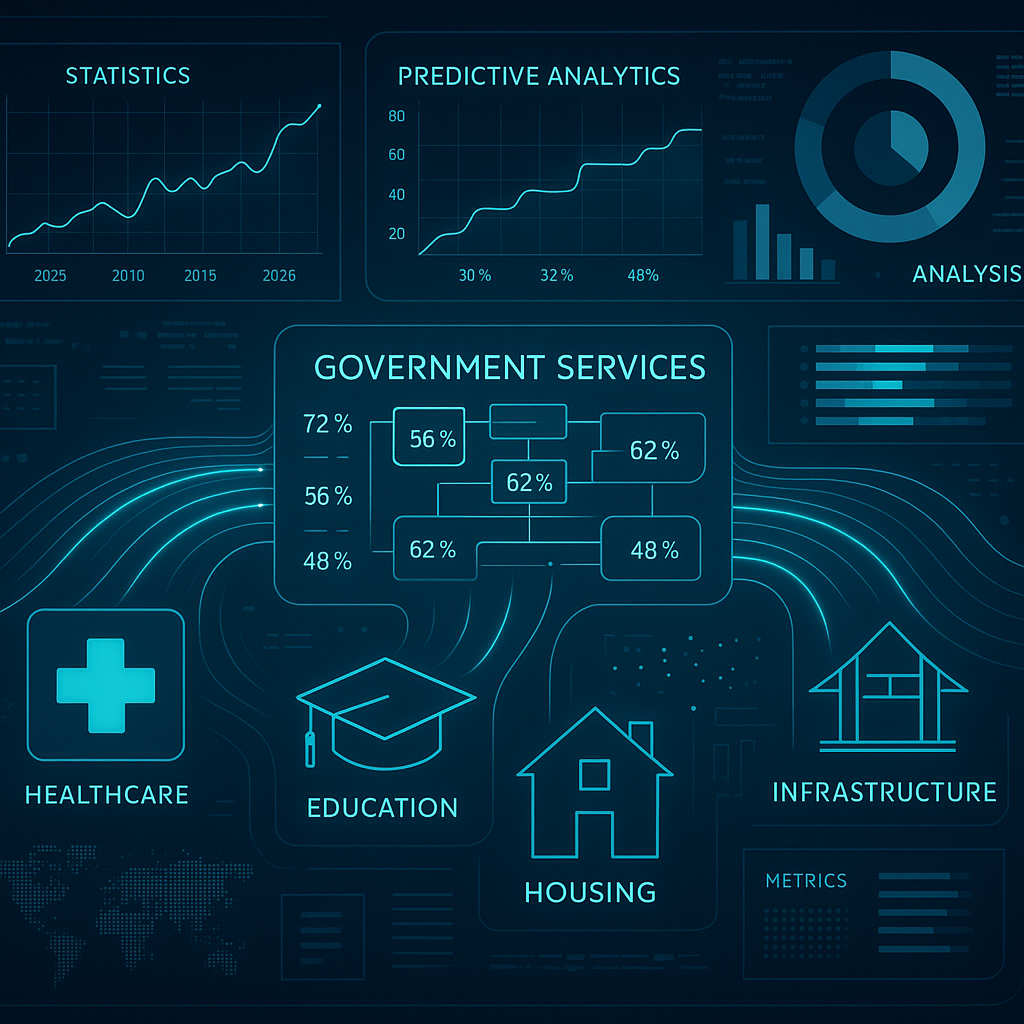
Discover how predictive data analytics is revolutionizing government operations, enabling agencies to anticipate citizen needs, optimize resource allocation, and deliver measurable outcomes across education, healthcare, housing, and public services.
From Reactive to Proactive: The Predictive Analytics Revolution in Public Sector
Government agencies have long operated in reactive mode—responding to crises after they emerge, allocating resources based on historical patterns, and addressing citizen needs only after problems surface. This approach, while familiar, leaves agencies perpetually one step behind. Predictive data analytics is changing that paradigm entirely, empowering public sector organizations to anticipate challenges, optimize interventions, and deliver proactive services that truly meet community needs before they escalate.
The transformation is profound. Instead of waiting for unemployment rates to spike, labor departments can now identify at-risk populations and deploy retraining programs early. Rather than reacting to public health emergencies, health agencies can predict disease outbreaks and mobilize resources preemptively. Housing authorities can forecast homelessness trends and intervene with supportive services before families lose their homes. This shift from reactive firefighting to proactive problem-solving represents a fundamental reimagining of how government serves its citizens.
What makes this revolution particularly exciting is the convergence of three factors: the exponential growth of government data, advances in machine learning algorithms, and cloud infrastructure that makes sophisticated analytics accessible to agencies of all sizes. Government organizations now have the tools to transform decades of siloed data into actionable intelligence that drives measurable outcomes. The question is no longer whether predictive analytics can work in the public sector—it's how quickly agencies can adopt these capabilities to better serve their communities.
Breaking Down Data Silos: Building the Foundation for Predictive Government Intelligence
The greatest barrier to predictive analytics in government isn't technology—it's fragmentation. Decades of legacy systems, departmental boundaries, and disconnected databases have created data silos that prevent agencies from seeing the complete picture. A family receiving housing assistance might also be enrolled in SNAP benefits, have children in the public school system, and be accessing healthcare through Medicaid—yet these touchpoints rarely communicate with each other. Breaking down these silos is the essential first step toward building predictive intelligence that actually works.
Successful data integration requires more than technical connectivity. It demands a strategic approach to data architecture that prioritizes interoperability, establishes common data standards, and implements robust governance frameworks. Master data management (MDM) becomes critical—ensuring that a single citizen or entity is consistently identified across systems. Data quality initiatives must address inconsistencies, duplicates, and gaps that undermine predictive model accuracy. And privacy-preserving techniques like data anonymization and secure enclaves enable agencies to collaborate on analytics while protecting sensitive information.
The payoff for this foundational work is substantial. When agencies can connect data across programs and departments, they unlock insights that would be impossible to achieve in isolation. Predictive models become dramatically more accurate when they can incorporate comprehensive data about individuals, communities, and environmental factors. Resource allocation becomes more efficient when agencies can identify overlapping services and coordinate interventions. Most importantly, citizens experience government as a cohesive support system rather than a maze of disconnected bureaucracies.
Building this foundation doesn't require a massive technology overhaul. Modern data integration platforms and enterprise architecture services can create logical connections between existing systems without requiring wholesale replacement. The key is starting with clear use cases—specific predictive analytics applications that will deliver measurable value—and building the data infrastructure to support them. This pragmatic, outcome-focused approach allows agencies to demonstrate value quickly while laying groundwork for more ambitious analytics initiatives over time.
Real-World Impact: How Predictive Analytics Drives Measurable Outcomes Across Government Services
The true test of any technology is its impact on real people and communities. Predictive analytics is already delivering measurable outcomes across every major area of government service. In education, school districts are using predictive models to identify students at risk of dropping out—sometimes years before they would have left school—and deploying targeted interventions that dramatically improve graduation rates. These models consider factors ranging from attendance patterns and grade trajectories to socioeconomic indicators and family circumstances, creating a holistic view of student success that enables truly personalized support.
Healthcare agencies are leveraging predictive analytics to transform population health management. By analyzing electronic health records, claims data, social determinants of health, and environmental factors, public health departments can identify communities at elevated risk for chronic disease, predict which patients are likely to require emergency services, and allocate preventive care resources where they'll have the greatest impact. During the pandemic, predictive models helped agencies forecast hospital capacity needs, identify vulnerable populations for vaccine prioritization, and optimize supply chain logistics for personal protective equipment.
In housing and human services, predictive analytics is enabling earlier, more effective interventions. Child welfare agencies use predictive models to assess risk and prioritize case investigations, helping protect vulnerable children while reducing unnecessary family disruption. Housing authorities predict which families are at highest risk of homelessness and provide targeted rental assistance and support services before crisis hits. Labor departments identify workers whose jobs are at risk due to automation or economic shifts and connect them with retraining programs aligned to growing industries in their regions.
Public safety and infrastructure management are also being transformed. Transportation agencies use predictive analytics to forecast traffic patterns, optimize signal timing, and plan maintenance before roads deteriorate. Emergency management agencies predict disaster impacts and pre-position resources to accelerate response. These applications share a common thread: they enable government to be proactive rather than reactive, to allocate limited resources where they'll have maximum impact, and to deliver services that genuinely improve citizens' lives. The measurable outcomes—higher graduation rates, reduced hospitalizations, fewer families experiencing homelessness, safer communities—demonstrate that predictive analytics isn't just a technological advancement, it's a fundamental improvement in how government serves its mission.
Navigating Compliance and Privacy: Predictive Analytics in Regulated Environments
Government agencies operate in the most regulated, scrutinized environment imaginable—and rightfully so. When you're working with citizens' most sensitive data—health records, financial information, children's educational data, criminal justice records—the stakes couldn't be higher. Implementing predictive analytics in this context requires navigating a complex web of privacy laws, security standards, and ethical considerations. The challenge is doing this in a way that protects individual rights while still enabling the data-driven insights that improve services.
Compliance frameworks like FedRAMP, NIST 800-53, FISMA, and sector-specific regulations like HIPAA and FERPA establish rigorous requirements for data security, access control, and privacy protection. Predictive analytics implementations must be architected from the ground up with these requirements in mind. This means implementing role-based access controls that ensure analysts only see data they're authorized to view, maintaining comprehensive audit trails that document every data access and model decision, and using encryption both in transit and at rest. It also means carefully evaluating cloud platforms and analytics tools to ensure they meet government security standards.
Beyond technical compliance, agencies must address the ethical dimensions of predictive analytics. How do you ensure that predictive models don't perpetuate or amplify historical biases? What transparency do citizens deserve about how predictive analytics influences decisions that affect their lives? How do you balance the potential benefits of predictive interventions against the risk of stigmatizing individuals or communities? These questions don't have simple answers, but they must be actively addressed through diverse stakeholder engagement, algorithmic fairness testing, and clear governance frameworks that establish when and how predictive analytics should be used.
The good news is that compliance and privacy protections don't have to be barriers to innovation—they can be guardrails that ensure predictive analytics is implemented responsibly. Privacy-preserving techniques like differential privacy, federated learning, and secure multi-party computation enable powerful analytics while minimizing exposure of individual-level data. Explainable AI methods help agencies understand and document how predictive models reach their conclusions, supporting both compliance requirements and public accountability. By building privacy and security into the foundation of predictive analytics initiatives rather than treating them as afterthoughts, agencies can move forward confidently, knowing they're protecting citizens while serving them better.
Accelerating Your Predictive Analytics Journey: Strategic Implementation for Government Agencies
The path to predictive analytics maturity doesn't require a massive, multi-year transformation program. The most successful government implementations start small, focus on specific high-value use cases, and build momentum through demonstrated results. Begin by identifying a challenge where predictive insights could drive measurable improvement—whether that's reducing recidivism, improving student outcomes, optimizing resource allocation, or enhancing service delivery. Choose a use case with clear success metrics, available data, and stakeholder support. This focused approach allows you to prove value quickly while building the capabilities and confidence for more ambitious initiatives.
Data readiness is often the limiting factor, so invest early in understanding what data you have, where it lives, and what quality issues need to be addressed. You don't need perfect data to start—you need good enough data and a clear plan for continuous improvement. Work with partners who understand both the technical requirements of data integration and the governance challenges of the public sector. Enterprise architecture services can help you map current systems, identify integration opportunities, and design a data architecture that supports both immediate analytics needs and long-term modernization goals.
Building internal capability is just as important as implementing technology. Predictive analytics requires a blend of data science expertise, domain knowledge, and change management skills. Consider a hybrid approach that combines external expertise for specialized analytics capabilities with internal team development to build sustainable capacity. Embed training into your implementation so that agency staff understand how predictive models work, how to interpret results, and how to incorporate insights into decision-making processes. Create feedback loops that allow frontline staff to validate predictions and improve model accuracy over time.
Finally, approach predictive analytics as a journey of continuous improvement rather than a one-time project. Start with simpler statistical models that establish baseline predictive capability, then evolve toward more sophisticated machine learning approaches as your data infrastructure and team capabilities mature. Measure outcomes rigorously and communicate results transparently—both successes and lessons learned. Engage stakeholders early and often, addressing concerns about privacy, fairness, and transparency proactively rather than defensively. By combining strategic focus, pragmatic implementation, and commitment to responsible innovation, government agencies can harness predictive analytics to deliver smarter, more proactive services that genuinely improve citizens' lives.