Microsoft Teams
Housing

Discover how AI-powered automation transforms requirements traceability from a compliance burden into a strategic advantage that accelerates delivery, reduces risk, and ensures regulatory alignment across complex IT projects.
The Hidden Cost of Manual Traceability in Modern Software Projects
Requirements traceability has long been the unsung hero of successful software projects—yet for most organizations, it remains one of the most time-consuming and error-prone activities in the development lifecycle. When teams manually track relationships between business requirements, system specifications, test cases, and validation messages, they're not just investing time—they're accumulating technical debt that compounds with every sprint, every regulatory update, and every stakeholder change request.
The financial impact is staggering. Organizations in regulated environments like healthcare, education, and government sectors often spend 20-30% of their project budgets on documentation and traceability activities. A mid-sized IT modernization project might require tracking thousands of individual requirements across multiple systems, policies, and compliance frameworks. When done manually, this creates bottlenecks that delay delivery timelines by weeks or even months, while increasing the risk of gaps that could lead to compliance failures or costly rework.
Beyond the direct costs, manual traceability creates hidden organizational friction. Teams lose momentum as they wait for documentation updates. Stakeholders struggle to understand impact when requirements change. Testing teams can't validate coverage effectively. And when audit time arrives, scrambling to produce traceability matrices becomes an all-hands emergency that pulls resources away from innovation and value delivery. The true cost isn't just measured in hours—it's measured in missed opportunities, delayed launches, and diminished competitive advantage.
Why Traditional Traceability Tools Fall Short in Regulated Environments
Traditional requirements management tools promised to solve traceability challenges, but they've largely failed to deliver on that promise in complex, regulated environments. These legacy platforms typically require extensive manual configuration, rigid taxonomies, and constant human intervention to maintain relationship mappings. While they may organize requirements better than spreadsheets, they don't fundamentally change the labor-intensive nature of traceability work.
The problem becomes acute when organizations need to demonstrate compliance with multiple overlapping frameworks—NIST 800 series, eCFR regulations, FedRAMP requirements, and agency-specific policies. Traditional tools lack the intelligence to automatically map requirements across these different standards. They can't identify when a change in one policy document impacts dozens of downstream technical specifications. And they certainly can't predict which test cases need updating when a business requirement evolves.
Version control presents another critical weakness. In government agencies and national labs where requirements documentation must be auditable and traceable across years of system evolution, traditional tools struggle to maintain coherent change histories. Teams end up with fragmented documentation spread across multiple repositories, making it nearly impossible to answer basic questions like 'Which version of this requirement was implemented in production?' or 'What was the original justification for this design decision?' This fragmentation doesn't just create compliance risk—it erodes institutional knowledge and makes vendor transitions unnecessarily disruptive.
Perhaps most importantly, traditional tools don't adapt to how modern teams actually work. They were designed for waterfall methodologies and struggle with the iterative, collaborative nature of Agile development. When product owners need to quickly understand the impact of a proposed change, or when testing teams need real-time visibility into coverage gaps, legacy traceability tools become obstacles rather than enablers. The result is that teams work around the tools rather than with them, defeating their entire purpose.
Automation as the Bridge Between Speed and Compliance
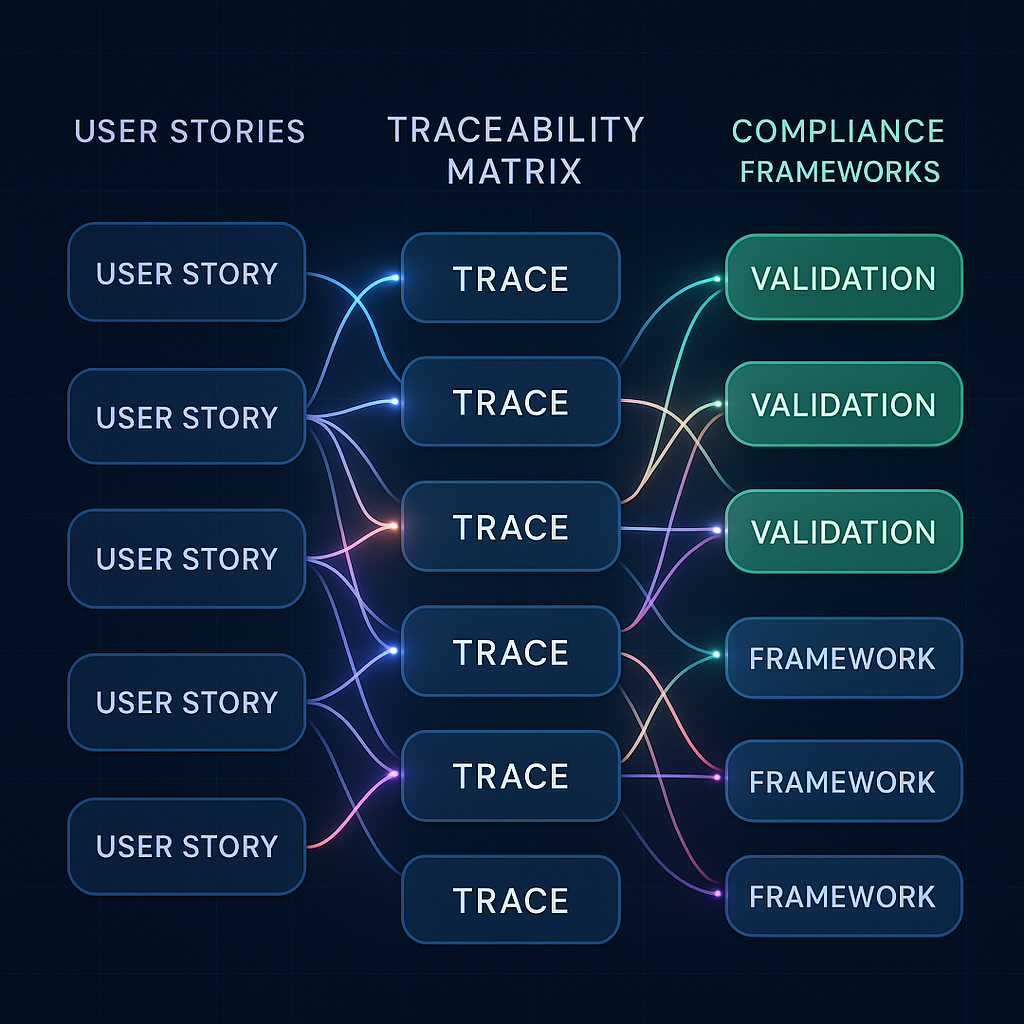
The breakthrough in modern requirements traceability comes from applying AI-powered automation that understands context, not just connections. Instead of forcing teams to manually draw lines between requirements, test cases, and validation messages, intelligent automation can analyze the semantic relationships between these artifacts and automatically generate comprehensive traceability matrices that evolve as the project progresses.
This isn't about replacing human judgment—it's about augmenting human expertise with computational power that can process vast amounts of structured data in seconds. When a business analyst updates a requirement, automated systems can immediately identify all downstream impacts: which user stories need revision, which acceptance criteria require updating, which test cases must be modified, and which compliance controls are affected. This real-time impact analysis transforms traceability from a retrospective documentation exercise into a proactive risk management tool.
The automation advantage becomes even more pronounced when dealing with regulatory compliance. AI-powered platforms can maintain living mappings between project requirements and compliance frameworks like NIST 800-53 or eCFR Title 45. When regulations change—as they inevitably do—automated systems can identify exactly which requirements need review, which implementations require updates, and which validation activities must be repeated. This capability is particularly valuable for organizations managing large portfolios of projects, where manual compliance tracking across dozens of initiatives would be prohibitively expensive.
Speed and compliance are no longer competing priorities. With deterministic AI that reduces hallucinations and maintains accuracy, organizations can generate comprehensive traceability documentation in minutes rather than weeks—without sacrificing the rigor that auditors and regulators demand. This acceleration doesn't just save time; it fundamentally changes what's possible. Teams can explore more design alternatives, respond faster to stakeholder feedback, and deliver value more frequently, all while maintaining the documentation discipline that regulated environments require.
Real-World Impact: From Weeks of Documentation to Minutes of Intelligence
The transformation from manual to automated traceability isn't theoretical—organizations are achieving measurable results that fundamentally change project economics. Consider a federal agency modernizing its case management system: using traditional methods, generating a complete traceability matrix linking 2,400 requirements to design specifications, test cases, and compliance controls required three full-time staff members working for six weeks. With AI-powered automation, the same organization now generates comprehensive traceability documentation in under 15 minutes, with automatic updates whenever requirements change.
The cost savings extend far beyond documentation labor. One healthcare organization implementing a new patient portal reduced their procurement costs by 65% by using automated requirements generation and traceability to create more precise, complete RFPs. Vendors could bid more accurately because the requirements were clearer and more thoroughly documented. The selection process moved faster because evaluation criteria were explicitly linked to technical requirements. And implementation proceeded more smoothly because the traceability matrix provided a clear roadmap from business needs to technical specifications to acceptance testing.
Perhaps most striking is the impact on project success rates. Organizations leveraging AI-powered requirements intelligence report dramatic improvements in on-time, on-budget delivery. When teams have real-time visibility into requirements coverage, when testing teams can instantly see which requirements lack adequate validation, and when stakeholders can quickly understand the impact of proposed changes, projects stay on track. One government contractor reported that automated traceability helped them identify 147 untested requirements three months before delivery—catching gaps that would have caused costly delays or compliance failures.
The intelligence advantage goes beyond speed and cost. Automated traceability creates a knowledge asset that persists beyond individual projects. When vendor transitions occur—a common challenge in government contracting—comprehensive traceability documentation ensures continuity. New teams can quickly understand the rationale behind design decisions, the relationships between requirements, and the validation approach. This institutional knowledge preservation is particularly valuable for long-lived systems that may operate for decades with multiple generations of support teams.
Building a Future-Ready Traceability Strategy with AI
The future of requirements traceability isn't about better spreadsheets or more sophisticated manual tools—it's about fundamentally reimagining traceability as an intelligent, automated capability that provides strategic value throughout the project lifecycle. Organizations building future-ready traceability strategies are starting with three key principles: automation first, intelligence built-in, and compliance by design.
Automation first means choosing platforms that generate traceability relationships automatically rather than requiring manual mapping. This includes automated generation of epics, features, user stories, and validation messages from high-level requirements, with AI-powered analysis that creates relationship mappings based on semantic understanding. The goal is to eliminate the manual labor that makes traceability a burden, freeing teams to focus on analysis and decision-making rather than documentation maintenance.
Intelligence built-in means leveraging AI that goes beyond simple keyword matching to understand context and relationships. This includes deterministic classical AI approaches that reduce hallucinations and improve accuracy, access to structured knowledge bases with millions of validated requirements patterns, and analytical capabilities that can identify coverage gaps, inconsistencies, and compliance risks automatically. The intelligence layer transforms traceability data from a static record into a dynamic decision support system.
Compliance by design means architecting traceability systems that align with regulatory frameworks from the ground up. This includes FedRAMP-compliant architecture for government projects, built-in mappings to standards like NIST 800 series and eCFR, role-based access controls that support audit requirements, and version control that maintains complete change histories. When compliance is embedded in the platform rather than bolted on afterward, organizations reduce risk while simplifying audit processes.
The strategic advantage of AI-powered traceability extends beyond individual projects. Organizations that implement these capabilities create a competitive moat in regulated markets where compliance complexity creates barriers to entry. They accelerate their ability to respond to RFPs, reduce the cost of vendor transitions, and improve their project success rates. Most importantly, they transform requirements traceability from a compliance burden into a strategic capability that enables faster innovation, better risk management, and more confident decision-making across their entire project portfolio.