
Microsoft Teams
Housing
Google Workspace
Microsoft 365
Cloud Security
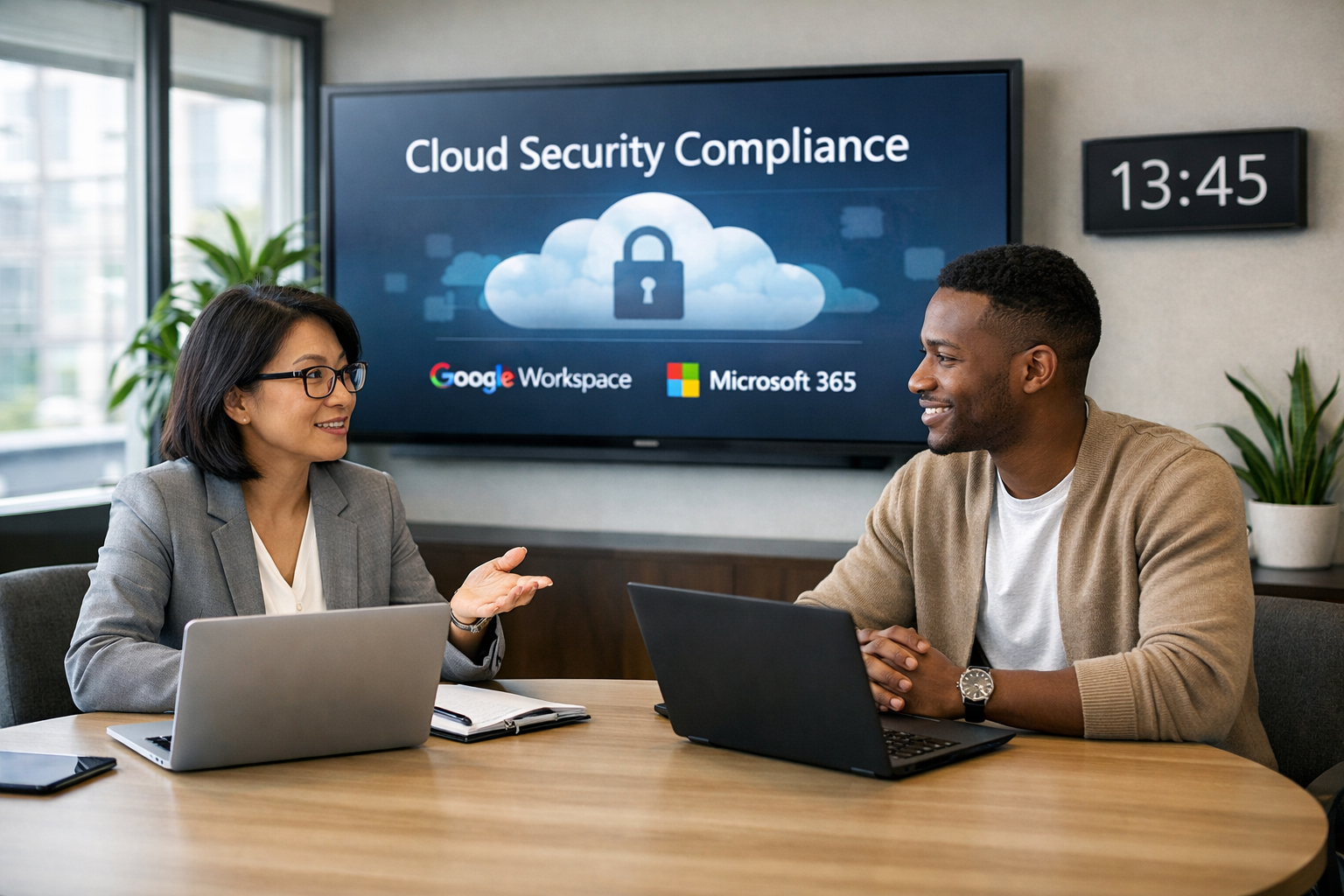
Ensuring Cloud Security Compliance with Google Workspace and Microsoft 365

Orca Intelligence
Ensuring Cloud Security Compliance with Google Workspace and Microsoft 365
13:45
As organizations migrate critical operations to cloud platforms, maintaining security compliance across Google Workspace and Microsoft 365 has become essential for protecting sensitive data while meeting regulatory mandates.
Navigating the Compliance Landscape in Modern Cloud Environments
Cross-functional organizations today face an increasingly complex regulatory landscape as they migrate to cloud platforms like Google Workspace and Microsoft 365. From HIPAA and FERPA requirements in healthcare and education to FedRAMP and NIST 800-53 standards in government sectors, the compliance mandates are diverse, overlapping, and constantly evolving. For executive directors managing non-profit missions or public sector innovation, understanding how these platforms address specific regulatory frameworks isn't just about checking boxes—it's about protecting stakeholder trust and ensuring uninterrupted access to mission-critical services.
Both Google Workspace and Microsoft 365 offer robust compliance certifications, but the real challenge lies in mapping your organization's unique regulatory requirements to the controls these platforms provide. Google Workspace supports compliance frameworks including ISO 27001, SOC 2, and FedRAMP Moderate, while Microsoft 365 extends coverage to include HIPAA, CJIS, and FedRAMP High. The key is developing a strategic approach that identifies which data classification levels exist within your organization, which compliance frameworks apply to each, and how your chosen platform's native controls align with those mandates. This proactive mapping transforms compliance from a reactive burden into a strategic advantage that accelerates digital transformation while maintaining regulatory integrity.
Cross-functional teams—spanning IT, legal, program delivery, and executive leadership—must collaborate to create a unified compliance strategy that transcends departmental silos. This collaborative approach ensures that security policies are not only technically sound but also operationally feasible and aligned with organizational mission delivery. By leveraging structured frameworks and AI-powered requirements intelligence tools, organizations can automate the mapping of thousands of regulatory requirements to specific platform controls, reducing weeks of manual analysis to minutes while improving accuracy and traceability across the entire compliance lifecycle.
Building a Foundation for Continuous Security Monitoring and Risk Assessment
Continuous security monitoring represents a fundamental shift from periodic audits to real-time risk visibility and proactive mitigation capabilities. For organizations leveraging Google Workspace or Microsoft 365, this means implementing intelligence-driven IT risk assessment frameworks that automatically track configuration changes, access patterns, anomalous behaviors, and potential vulnerabilities across your entire cloud ecosystem. Google's Security Center and Microsoft's Defender for Cloud Apps provide native monitoring capabilities, but transforming these tools into actionable intelligence requires strategic configuration aligned with your organization's risk tolerance and compliance obligations.
Establishing effective continuous monitoring begins with defining baseline security configurations that reflect both industry best practices and your specific regulatory requirements. This includes implementing automated alerting for configuration drift, privileged access usage, data exfiltration attempts, and failed authentication patterns. Cross-functional organizations particularly benefit from risk assessment dashboards that translate technical security events into business impact metrics—enabling executive directors to understand not just what happened, but what it means for mission delivery, stakeholder confidence, and regulatory compliance. By automating risk identification and traceability across complex cloud environments, organizations reduce the administrative overhead traditionally associated with compliance while actually improving their security posture.
The most innovative organizations are moving beyond reactive monitoring to predictive risk assessment, leveraging analytics and machine learning to identify potential vulnerabilities before they're exploited. This proactive approach aligns perfectly with the goal of achieving continuous Authority to Operate (ATO) and integrating DevSecOps practices throughout the development lifecycle. When security monitoring is embedded into daily operations rather than treated as a separate compliance exercise, organizations can maintain data integrity, prevent unauthorized modifications, and respond to cybersecurity threats with the speed and confidence modern missions demand. Strategic vendor management plays a critical role here—ensuring that third-party integrations with Google Workspace or Microsoft 365 maintain consistent security standards and don't introduce gaps in your monitoring coverage.
Implementing Access Controls and Data Governance Frameworks
Access controls form the cornerstone of cloud security compliance, determining who can access what data, when, and under what conditions. Both Google Workspace and Microsoft 365 offer sophisticated identity and access management (IAM) capabilities, including single sign-on, multi-factor authentication, conditional access policies, and privileged access management. However, implementing these controls effectively requires a comprehensive data governance framework that classifies information assets, defines appropriate access levels for different user roles, and establishes clear policies for data lifecycle management across creation, sharing, retention, and deletion.
For cross-functional organizations, the challenge lies in balancing security requirements with operational efficiency. Overly restrictive access controls can impede collaboration and slow mission delivery, while overly permissive policies expose sensitive data to unauthorized access or modifications. The solution is implementing a zero-trust security model combined with context-aware access controls that adapt based on user identity, device health, location, and data sensitivity. Google Workspace's Context-Aware Access and Microsoft 365's Conditional Access enable organizations to enforce granular policies that maintain security without sacrificing agility—allowing teams to collaborate freely on non-sensitive content while automatically applying additional verification steps for protected data.
Data governance frameworks must extend beyond access controls to encompass data loss prevention (DLP), encryption at rest and in transit, and automated data classification. Microsoft 365's Information Protection capabilities and Google Workspace's Data Loss Prevention tools allow organizations to automatically identify sensitive information—such as Social Security numbers, credit card data, or protected health information—and apply appropriate protection policies without requiring manual intervention. This automation is particularly valuable for non-profit organizations and government agencies that handle diverse data types across education, healthcare, housing, and workforce programs. By sustaining data governance frameworks with minimal human intervention, organizations can maintain compliance posture even during operational freezes, staff transitions, or other disruptions that traditionally create security gaps.
Automating Compliance Validation and Audit Trail Management
Manual compliance validation processes are not only time-consuming and error-prone—they're fundamentally incompatible with the dynamic nature of modern cloud environments. When configurations change daily, users are added and removed constantly, and data flows across multiple systems, maintaining compliance through periodic manual audits creates dangerous gaps where violations can persist undetected. Automating compliance validation transforms this reactive approach into a continuous process that identifies and remediates issues in real-time, ensuring that every technical specification, regulatory mandate, and stakeholder need is systematically validated throughout the operational lifecycle.
Both Google Workspace and Microsoft 365 provide comprehensive audit logging capabilities that capture detailed information about user activities, administrative changes, and system events. Microsoft 365's Unified Audit Log and Google Workspace's Audit and Investigation tools create immutable records that satisfy regulatory requirements for audit trail retention and forensic investigation. However, collecting logs is only the first step—organizations must implement automated analysis workflows that continuously assess log data against compliance requirements, identify anomalies or policy violations, and trigger appropriate remediation workflows. This automation enables organizations to visualize and manage compliance coverage across their entire vendor pool, demonstrating clear alignment from business needs to vendor capabilities to validation evidence.
The most effective compliance automation strategies leverage AI and machine learning to transform vast quantities of audit data into actionable intelligence. Rather than requiring security teams to manually review thousands of log entries, intelligent systems can automatically correlate events, identify suspicious patterns, and generate compliance reports that demonstrate adherence to specific regulatory requirements. This approach reduces procurement costs, accelerates vendor evaluation cycles, and improves project success rates by providing stakeholders with real-time visibility into compliance status. For organizations pursuing continuous ATO or other risk management frameworks, automated compliance validation creates the evidence base necessary to maintain certification while reducing the administrative burden on technical teams. By enabling dynamic management of traceability data throughout the procurement and operational lifecycle, organizations can respond to auditor inquiries in minutes rather than days, transforming compliance from a periodic burden into a continuous strategic advantage.
Sustaining Long-Term Compliance Through Strategic Vendor Management
Achieving initial compliance with Google Workspace or Microsoft 365 is a significant accomplishment, but sustaining that compliance over time requires strategic vendor management that extends beyond the platforms themselves. Cross-functional organizations typically rely on dozens or even hundreds of third-party applications and integrations that connect to their cloud productivity suites—each representing a potential compliance risk if not properly vetted, monitored, and managed. Effective vendor management transforms these relationships from potential vulnerabilities into strategic assets that enhance rather than compromise your security posture.
Strategic vendor management begins with implementing comprehensive vendor risk assessment processes that evaluate third-party applications before granting access to Google Workspace or Microsoft 365 data. This assessment should examine the vendor's own compliance certifications, security practices, data handling policies, and incident response capabilities. Organizations can leverage application governance features like Google Workspace Marketplace vetting and Microsoft's App Governance to gain visibility into which third-party apps are accessing organizational data, what permissions they've been granted, and how actively they're being used. By establishing clear policies for application approval, periodic reviews of existing integrations, and automated alerts for high-risk permission requests, organizations can maintain oversight of their third-party vendor ecosystem without creating bottlenecks that impede innovation.
Long-term compliance sustainability also requires maintaining current documentation of your cloud security architecture, control implementations, and compliance mappings as both your organization and the platforms themselves evolve. Google and Microsoft regularly release new features, update security controls, and obtain additional compliance certifications—changes that may require updating your compliance documentation and control testing procedures. Rather than treating this as a manual burden, innovative organizations are leveraging AI-powered requirements intelligence tools to automate traceability creation, maintenance, and analysis throughout the compliance lifecycle. This approach reduces implementation costs by up to 65%, accelerates procurement timelines, and improves stakeholder confidence by demonstrating that compliance is not just achieved but actively sustained through systematic processes and intelligent automation. By transforming vendor selection from guesswork into strategic precision and maintaining rigorous oversight of the entire technology ecosystem, organizations can drive growth and protect their missions while meeting evolving regulatory mandates with confidence and efficiency.